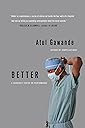
Better
Product ID: 1700515
Desertcart purchases this item on your behalf and handles shipping, customs, and support to Cape Verde.
NATIONAL BESTSELLER The New York Times bestselling author of Being Mortal and Complications examines, in riveting accounts of medical failure and triumph, how success is achieved in a complex and risk-filled profession. The struggle to perform well is universal: each one of us faces fatigue, limited resources, and imperfect abilities in whatever we do. But nowhere is this drive to do better more important than in medicine, where lives are on the line with every decision. In this book, Atul Gawande explores how doctors strive to close the gap between best intentions and best performance in the face of obstacles that sometimes seem insurmountable. Gawande's gripping stories of diligence, ingenuity, and what it means to do right by people take us to battlefield surgical tents in Iraq, to labor and delivery rooms in Boston, to a polio outbreak in India, and to malpractice courtrooms around the country. He discusses the ethical dilemmas of doctors' participation in lethal injections, examines the influence of money on modern medicine, and recounts the astoundingly contentious history of hand washing. And as in all his writing, Gawande gives us an inside look at his own life as a practicing surgeon, offering a searingly honest firsthand account of work in a field where mistakes are both unavoidable and unthinkable. At once unflinching and compassionate, Better is an exhilarating journey narrated by "arguably the best nonfiction doctor-writer around" ( Salon ). Gawande's investigation into medical professionals and how they progress from merely good to great provides rare insight into the elements of success, illuminating every area of human endeavor. Review: Though-provoking and a terrific read - This is a non-fiction book so compellingly written it begs to be read in one sitting like a novel. And luckily it's short enough for the reader to do just that and come away with useful insights. Readers seem to get different things from this book. Some are most interested in the chapters on medical ethics. What I found most interesting was what I took as the main theme: that the practice of medicine is complex; that through attention to detail in can be systematically improved in non-obvious, pragmatic ways that are far from the big-money, high-profile research our attention is usually drawn to; and that this improvement can come from dedicated individuals and groups all over the world. Even better, some of the lessons here can carry over to other disciplines. My job has no relation to medicine but I found this book to provoke lots of ideas for my own work. Thanks, Dr. Gawande. A previous reviewer felt that the author's work was becoming "conceited." I have to disagree; I found it refreshingly self-effacing. Unlike some books written by surgeons, this one isn't focused on the tribulations or poetry of the practice of medicine. Rather, it's focused on how practitioners with no more than average skills could help make medicine serve humanity better. Review: Atul Guwande is a fantastic writer - One of my favorite books on medical topics. Atul Guwande is a fantastic writer, knowledgeable, empathetic, just an all-around good read. The initial chapter on hospital-borne infections, hand washing, and the reference to the work on positive deviance and childhood malnutrition in Vietnam is eye opening. I've given away several copies.
| Best Sellers Rank | #62,733 in Books ( See Top 100 in Books ) #8 in General Surgery #36 in Medical Reference (Books) #82 in Health, Mind & Body Reference |
| Customer Reviews | 4.6 out of 5 stars 4,001 Reviews |
A**R
Though-provoking and a terrific read
This is a non-fiction book so compellingly written it begs to be read in one sitting like a novel. And luckily it's short enough for the reader to do just that and come away with useful insights. Readers seem to get different things from this book. Some are most interested in the chapters on medical ethics. What I found most interesting was what I took as the main theme: that the practice of medicine is complex; that through attention to detail in can be systematically improved in non-obvious, pragmatic ways that are far from the big-money, high-profile research our attention is usually drawn to; and that this improvement can come from dedicated individuals and groups all over the world. Even better, some of the lessons here can carry over to other disciplines. My job has no relation to medicine but I found this book to provoke lots of ideas for my own work. Thanks, Dr. Gawande. A previous reviewer felt that the author's work was becoming "conceited." I have to disagree; I found it refreshingly self-effacing. Unlike some books written by surgeons, this one isn't focused on the tribulations or poetry of the practice of medicine. Rather, it's focused on how practitioners with no more than average skills could help make medicine serve humanity better.
T**A
Atul Guwande is a fantastic writer
One of my favorite books on medical topics. Atul Guwande is a fantastic writer, knowledgeable, empathetic, just an all-around good read. The initial chapter on hospital-borne infections, hand washing, and the reference to the work on positive deviance and childhood malnutrition in Vietnam is eye opening. I've given away several copies.
E**2
Different medicine perspective
Admittedly, I had just finished "Hot Lights, Cold Steel" which has turned out to be one of my all time favorites, when I picked up this book. I had heard good things and I was not disappointed. That being said, I felt a few chapters fell a little short of their mark and a still others were hard to keep going. I found myself skipping to the end of a couple chapters. The good thing about this book however is that it's almost a series of completely unrelated short stories so if you don't like the one you are reading...move on to the next one. I very much enjoyed learning of the OB/Gyn profession. That chapter was fairly fascinating.
R**I
Very good read
The medical system is filled with compromise, problems and lack of understanding. Variants of care vary drastically from place to place without a complete understanding of how or why. Questions of ethics, morals and codes doctors must abide by with little oversight. Understanding the medical system is a tedious and seemingly hopeless task. One must often wonder, what holds this system together? Dr. Atul Gawande has taken a selection of real life stories of great and inspiring acts in the field of medicine. His portrayal of these stories is even inspiring to those who have no interest in medicine. His description of a hospital team that's primary job is preventing infection. There struggle to get people to simply keep their hands clean was daunting. However it proved when you involve everyone in the solution you can more effectively fix the problem. His description of FST (Field Surgical Teams) in Iraq was eye opening. Little attention by the press was given to this handful of surgeons who saved countless soldiers and civilians lives. One of their greatest accomplishments being the tedious collection of information, which ultimately helped shape war time trauma care. The depiction of the Adgars scale and how its creation dramatically increased newborn mortality rates. It was created by an unlikely Anesthesiologist, the second female in the country given this title. I could go on, however I will save the book for your reading. Overall the book beat my expectations, so I would recommend reading it. It will inspire you to seek to do "Better". You will feel as though however small your achievements it's the collective efforts of us all that overcome all odds.
L**D
A lovely read
Absolutely loved this books. A must read for anybody wanting to improve on anything
S**K
Better: Good for more than just those interested in medicine
I enjoyed reading Better for the insights it gave into the various forces shaping medical practice, and how important the individual and collaboration are in a profession one often thinks of as the being dominated by individual practitioners with highly specialized skills. What was especially interesting to me was how this book brought to mind parallels with what seems to be a vastly different profession: software development. ALmost every chapter brought to mind a parallel. The stories of practice in rural India seemed to make a case for the value of "generalizing specialists," the discussion of infection prevention was an echo of the value (and difficulty) of getting a team to be disciplined in using a few simple practices, etc. I suspect those in other fields that require individual skill, judgement, and collaboration might find the same thing. This wasn't unexpected, as I had first read The Checklist Manifesto: How to Get Things Right , but that book was explicit about the parallels. If you are interested in health care, want to understand how to apply skills more effectively, or simply just like a good story, Better is good, Gawande mixes anecdote, data, and an almost suspenseful presentation style to make what could be an academic discussion approachable and entertaining.
F**R
Book it good but..
The book is great . I ended up buying it for a school project, and I only had a couple of days to do it. I ordered it with prime expecting it to get here fast and for a good price. But when I revived the package there was nothing it there it was empty. It looked like it was never sealed. I had bought another one after getting a refund . But then it said it didn’t go through so I had to buys another one. In the end I ended up with three books because it turned out the first book I bought they had delivered it back. But great book.
M**A
A Medical Drama - an insider looking out
Atul Gawande asks the hard questions. How can a doctor who is just a human be expected to be a god? Gawande looks at the profession from the mundane (hand washing) to the ethical mountain tops (physicians attending executions). The odd thing is that the death row docs have not killed nearly as many people, in the big picture, as the ones who forget to sufficiently scrub up. Dr. Gawande tells us about the challenges and changes in obstetrics, cystic fibrosis, and the use of chaperones in examining rooms, trauma practice and many other little niches in the health care system from an insider's point of view. This is a well written real life look into the daily life of a modern day physician documenting all the medical and ethical decisions that affect both the doc and the patient. He is quite frank with many of his judgment calls but never gets too technical that the book is difficult to read for the layman. This is a good read.....BG
D**A
Tienes que leerlo
El libro es lo máximo
M**7
Masterpiece !
He even writes for the New Yorker !! His storytelling is superb .
V**O
Interesting
Interesting read for anyone who's spent any amount of time in a hospital. gives a different outlook into health care.
K**I
good
good
J**M
Not your average deviant
Take aways that stand out: pick something that gets you up every morning; change it; count it; write about it; ask for feedback; don't complain; a refreshingly positive deviant.
Trustpilot
2 weeks ago
1 month ago