
Desertcart purchases this item on your behalf and handles shipping, customs, and support to Cape Verde.
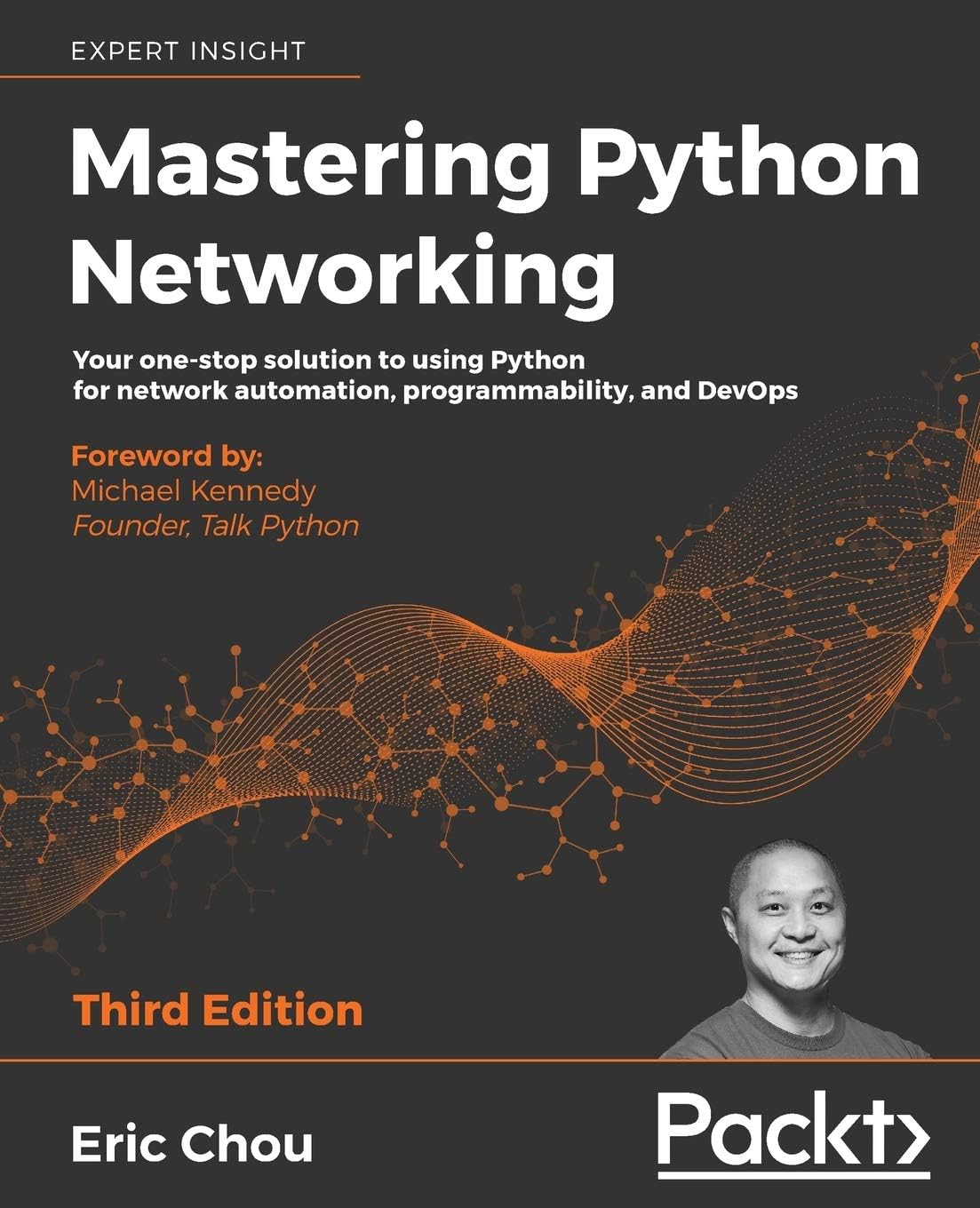
New edition of the bestselling guide to mastering Python Networking, updated to Python 3 and including the latest on network data analysis, Cloud Networking, Ansible 2.8, and new libraries Key Features Explore the power of Python libraries to tackle difficult network problems efficiently and effectively, including pyATS, Nornir, and Ansible 2.8 Use Python and Ansible for DevOps, network device automation, DevOps, and software-defined networking Become an expert in implementing advanced network-related tasks with Python 3 Book Description Networks in your infrastructure set the foundation for how your application can be deployed, maintained, and serviced. Python is the ideal language for network engineers to explore tools that were previously available to systems engineers and application developers. In Mastering Python Networking, Third edition, you'll embark on a Python-based journey to transition from traditional network engineers to network developers ready for the next-generation of networks. This new edition is completely revised and updated to work with Python 3. In addition to new chapters on network data analysis with ELK stack (Elasticsearch, Logstash, Kibana, and Beats) and Azure Cloud Networking, it includes updates on using newer libraries such as pyATS and Nornir, as well as Ansible 2.8. Each chapter is updated with the latest libraries with working examples to ensure compatibility and understanding of the concepts. Starting with a basic overview of Python, the book teaches you how it can interact with both legacy and API-enabled network devices. You will learn to leverage high-level Python packages and frameworks to perform network automation tasks, monitoring, management, and enhanced network security followed by Azure and AWS Cloud networking. Finally, you will use Jenkins for continuous integration as well as testing tools to verify your network. What you will learn Use Python libraries to interact with your network Integrate Ansible 2.8 using Python to control Cisco, Juniper, and Arista network devices Leverage existing Flask web frameworks to construct high-level APIs Learn how to build virtual networks in the AWS & Azure Cloud Learn how to use Elastic Stack for network data analysis Understand how Jenkins can be used to automatically deploy changes in your network Use PyTest and Unittest for Test-Driven Network Development in networking engineering with Python Who this book is for Mastering Python Networking, Third edition is for network engineers, developers, and SREs who want to use Python for network automation, programmability, and data analysis. Basic familiarity with Python programming and networking-related concepts such as Transmission Control Protocol/Internet Protocol (TCP/IP) will be useful. Table of Contents Review of TCP/IP Protocol Suite and Python Low-Level Network Device Interactions APIs and Intent-Driven Networking The Python Automation Framework - Ansible Basics The Python Automation Framework - Beyond Basics Network Security with Python Network Monitoring with Python - Part 1 Network Monitoring with Python - Part 2 Building Network Web Services with Python AWS Cloud Networking Azure Cloud Networking Network Data Analysis with Elastic Stack Working with Git Continuous Integration with Jenkins Test-Driven Development for Networks Review: Great read and publisher! - This is a great read. I recommend it 100%. Additionally, I want to mention how accommodating the publisher was when I lost my book. I never got around to requesting the PDF when I had the physical copy and only realized it once I had forgotten my book on the train ride home. I quickly reached out to them and provided my invoice and the turnaround for the digital request was almost instantaneous. I would consider purchasing more books from them any time!!! Review: If you are in the audience for this book, then buy it else there are better alternatives - Eric Chou is a genius. This book is extremely well written and very useful - for the people who do the things he explains how to do. However, the number of people who do that kind of stuff is very, very small. If you understand OSPF, BGP, EGP, and maybe VIRL (look up VIRL and see if you are interested in it), then buy the book. If these are cryptic acronyms, then buy a different book because Eric's book goes into gory detail about how to automate such things. You will sleep better knowing that there are people who do know how to do these things, and thanks in part to Eric's book, do it so well you don't need to know. If you are working on a router at 3 AM, then definitely buy the book because you are doing something wrong - this book *will* help you.


| Best Sellers Rank | #1,018,180 in Books ( See Top 100 in Books ) #182 in Web Services #653 in Computer Networks, Protocols & APIs (Books) #715 in Computer Networking (Books) |
| Customer Reviews | 4.7 out of 5 stars 161 Reviews |
A**A
Great read and publisher!
This is a great read. I recommend it 100%. Additionally, I want to mention how accommodating the publisher was when I lost my book. I never got around to requesting the PDF when I had the physical copy and only realized it once I had forgotten my book on the train ride home. I quickly reached out to them and provided my invoice and the turnaround for the digital request was almost instantaneous. I would consider purchasing more books from them any time!!!
J**.
If you are in the audience for this book, then buy it else there are better alternatives
Eric Chou is a genius. This book is extremely well written and very useful - for the people who do the things he explains how to do. However, the number of people who do that kind of stuff is very, very small. If you understand OSPF, BGP, EGP, and maybe VIRL (look up VIRL and see if you are interested in it), then buy the book. If these are cryptic acronyms, then buy a different book because Eric's book goes into gory detail about how to automate such things. You will sleep better knowing that there are people who do know how to do these things, and thanks in part to Eric's book, do it so well you don't need to know. If you are working on a router at 3 AM, then definitely buy the book because you are doing something wrong - this book *will* help you.
K**R
Automation is the networking skill to have and for that you need this particular book!
I have been a network engineer for years now and I needed to get up to speed on automation as quickly and efficiently as possible. I wanted a reference book that got right to the meat of what I needed to know. This is that book. It was recommended to me by another network engineer and I was so impressed with it that I took him out for a couple of beers for his willingness to bring this book to my attention. It is a book that you will be glad you have in your home technical library because you will reference it time and time again. My boss was so impressed with the new skills I learned from this book that he referenced my mastery of automation in my latest review and then compensated me accordingly.
G**A
Good reference for experienced programmer.
A bit beyond my capabilities but a good reference for an experienced programmer
C**E
Very information dense, but in a good way
First off, I'll be honest. I haven't read the entire book yet, but that's because it is 500+ pages. However, even if you just look at the table of contents, you know that you're getting your money's worth. The book starts out with the customary review of Python and basic networking concepts. Then it jumps into working w/ legacy network devices in a command line interface using a variety of Python libraries, and follows that up by talking about higher-level interaction through device APIs. Several chapters cover automation via Ansible framework, Jinja2 templating, and custom modules. A valuable chapter is network security using Python, such as Scapy, syslog searching, and automation of admin work using Python. A nice touch is the inclusion of data visualization. It is common for books to focus on command line output or text-based files, maybe at most creating tables. Visualization is commonly left to web site development, such as making a web page to create a network dashboard. Being able to generate graphs and charts is handy, especially when you want to create presentations or show other people what the network is doing. The last few chapters delve into cloud services, version control, continuous integration, and test-driven development. These topics are commonly relegated to separate books or other media, so it's nice to get them in one place, especially for people who may not have ever dealt with them before. I suspect a number of network engineers aren't familiar w/ the DevOps process, so having a crash course in current best-practices can be helpful. Overall, this is a very comprehensive book and even if you are just curious about how to work with networks beyond the basic Python sockets, this is a valuable resource.
T**K
Network Automation Bootcamp in a Book
There's a ton of moving pieces in the network automation world, from libraries and orchestration frameworks, sources of truth and continuous deployment of changes. This book covers a wide range of these topics, along with context of the current state of network automation, to allow the reader to hit the ground running and bringing significant time savings and reliability to network operations. A pattern that I see in each topic Eric covers is that he explains the "why" along with the "how", so readers can get an idea of the philosophy behind each tool to make sure that usage is idiomatic and they're not fighting against the grain. As a big fan of Scapy, I think Eric's intro to the tool is clear and provides some high value tools with short code examples. When you get the foundations right on such a powerful library, the possibilities are endless and this chapter guides the reader in the right direction. I also loved the chapters about Ansible! I don't use Ansible in my environment currently, so having a guide that goes beyond "Hello World" with real device examples covering templates, variables, and all the little details that I need to actually use this in my network is incredibly helpful.
A**U
Another masterpiece!
I was fortunate enough to be allowed to tech review the book for Eric on the 1st edition, and what a treat that was! I learned a great deal of things from reviewing the content and personally verifying all the labs. To see Eric continuing to evolve this book and adding new, high value and practical contents that are really helpful for the network engineer community, is really a delight. I got the 3rd edition and immediately started reading the ElasticStack chapter, b/c it applies to what I am currently doing. This shows that his contents, and his industry knowledge about what devops practices is useful for the networking community, is unparalleled. High recommended, as always!
M**Y
Great Read!! Hats off to Eric.
Bought the eBook off Packt early this morning and have already skimmed the book. Reviewed the new chapters and bookmarked the chapters I need to dig deeper into and go through in my lab. As a longtime network engineer, content like this is more important than ever to learn. I have the Second Edition of this book and jumped on his Third Edition! Author always is clear and covers current content, it gives you a start in many concepts and shows you the way. Love that the ElasticStack was added, also a key addition with Genie and PyATS the last chapter of the book.
P**L
Well written
Well written, easy to understand. Good goto for network enginners looking into automation.
K**I
Big book.😎
I am interesting in learning python for networking and all, but only problem why I didn't give an 4/5 star is because it's old book.😅😒
M**O
pesimo libro, me arrepiento de la compra
sin ejemplos reales, sin explicación, sin casos útiles, básicamente tienes que ser el autor para comprender el libro,codigo con errores o incompleto , el peor libro que e comprado ,y la información de apoyo no tiene orden, no cabeza, no sirve de nada este libro.
N**3
Parfait
Pour l’exploitation des équipements reseaux
F**L
A great guide for becoming an adept, but certainly not a master.
as an example the ElasticSearch chapter: the book covers almost all important aspects: - basic logstash use and use case - basic filebeat use and use case - interfacing with ES with a very simple example search - making a very simple dashboard We miss out on ElastAlert and alternatives. We don't do anything with the information we gather. We don't see any example that is advanced usage. There's no mention of Elastiflow... There's only rough advice where to go from there. It would need so much more to be rightfully be called mastery! That chapter's hardly an apprentice, more like a good internship. Don't get me wrong, it's worthwhile, it's a great way to make sure you know your tools - wide and far the best overview also. But the mastery stays your problem.
Trustpilot
5 days ago
2 days ago